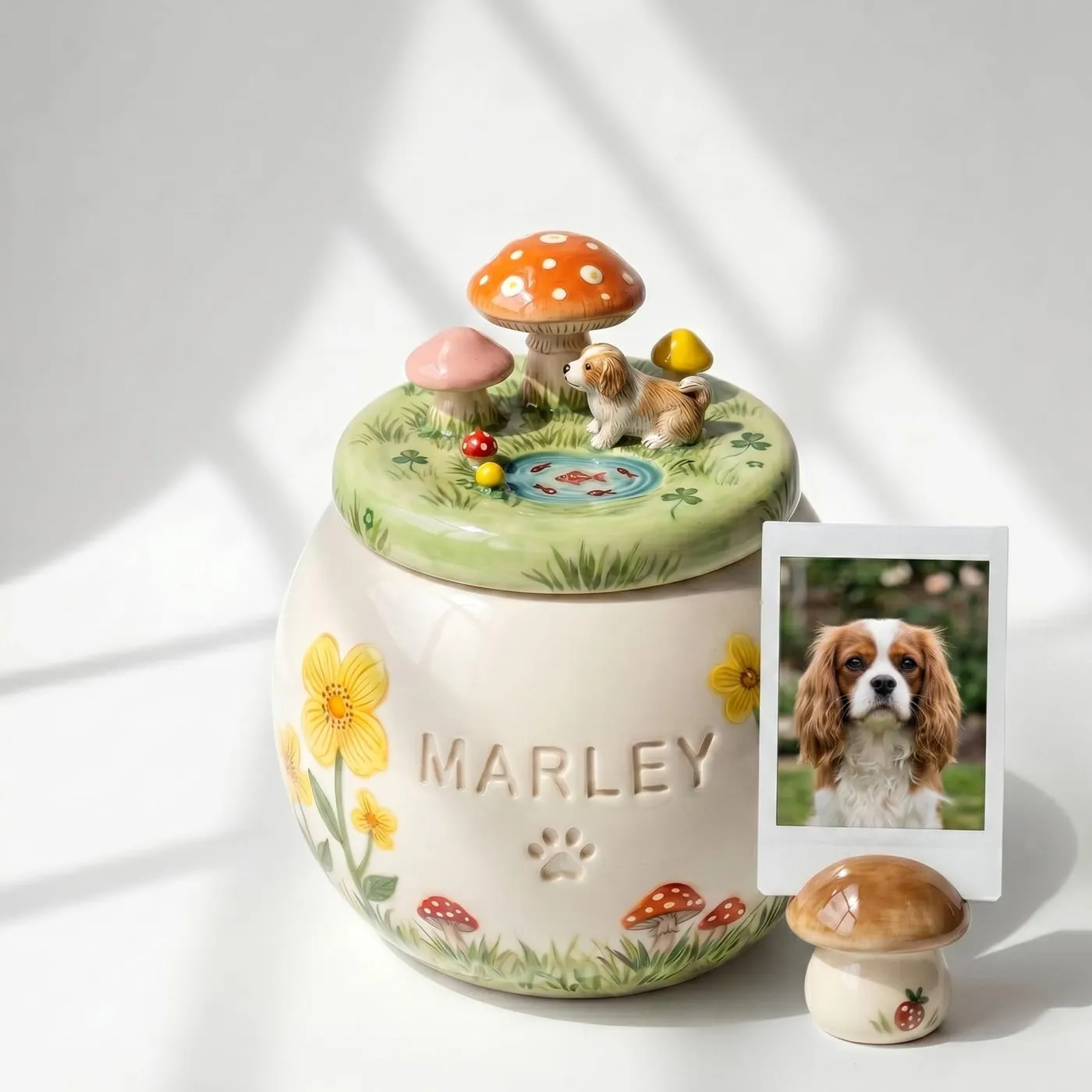
Painted or Raised? How the Designs on Our Pet Urns Are Made
Some urn designs are brushed onto the clay, some are built up from it, and some are shaped into the jar itself. How each one is made and what it changes for you.
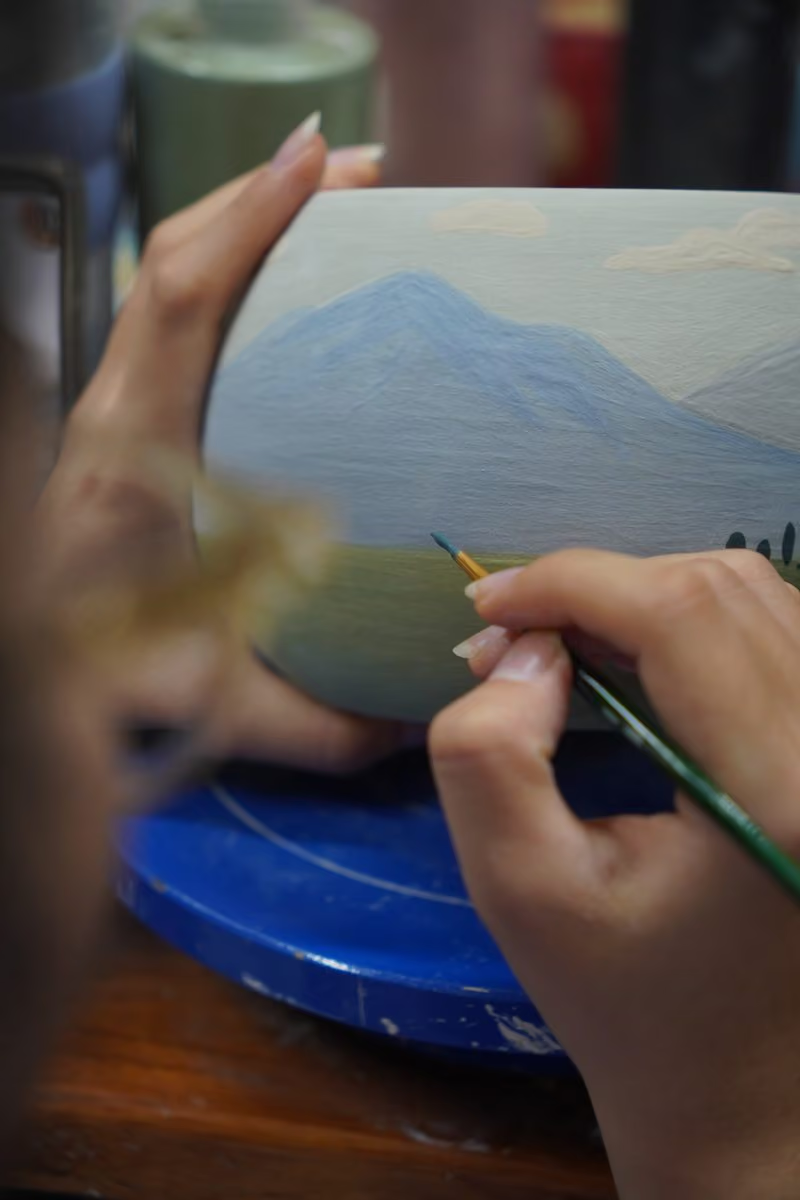
A hand-painted ceramic pet urn and a raised one are made in two different ways: paint is brushed onto the surface and stays flat, while raised work is extra clay joined to the jar, so it stands out and you can feel it. Most Pepple Studio urn designs use one of the two, some use both, and three also have an arched alcove built into the jar.
Which method a design uses decides how it looks in changing light, how long it takes to make and how much can go wrong before it comes out of the kiln at 1200°C.
How is a hand-painted ceramic pet urn decorated?
A hand-painted ceramic pet urn from Pepple Studio has its design put on with a brush, by hand, before the piece is fired at 1200°C. On the Cherry Blossom design the petals are painted one at a time onto clay that has dried but not yet been fired, which lets the pink soak into the surface instead of resting on top of it. Night Sky and Hand-Painted Meadow take their scene all the way round the jar, so there is no blank back and the urn can face any way on a shelf.
What goes on with the brush is not quite what comes out of the kiln. Pink blossom darkens a little in the heat, so the glaze is chosen a shade paler than the pink we want at the end. Blues move more than most colours, and for larger Ocean & Nautical commissions a test tile goes into the kiln beside the urn, so the colour you are shown is real fired glaze rather than a screen’s guess at it. On Night Sky the smooth, glossy glaze over the painting is what keeps the colours soft.
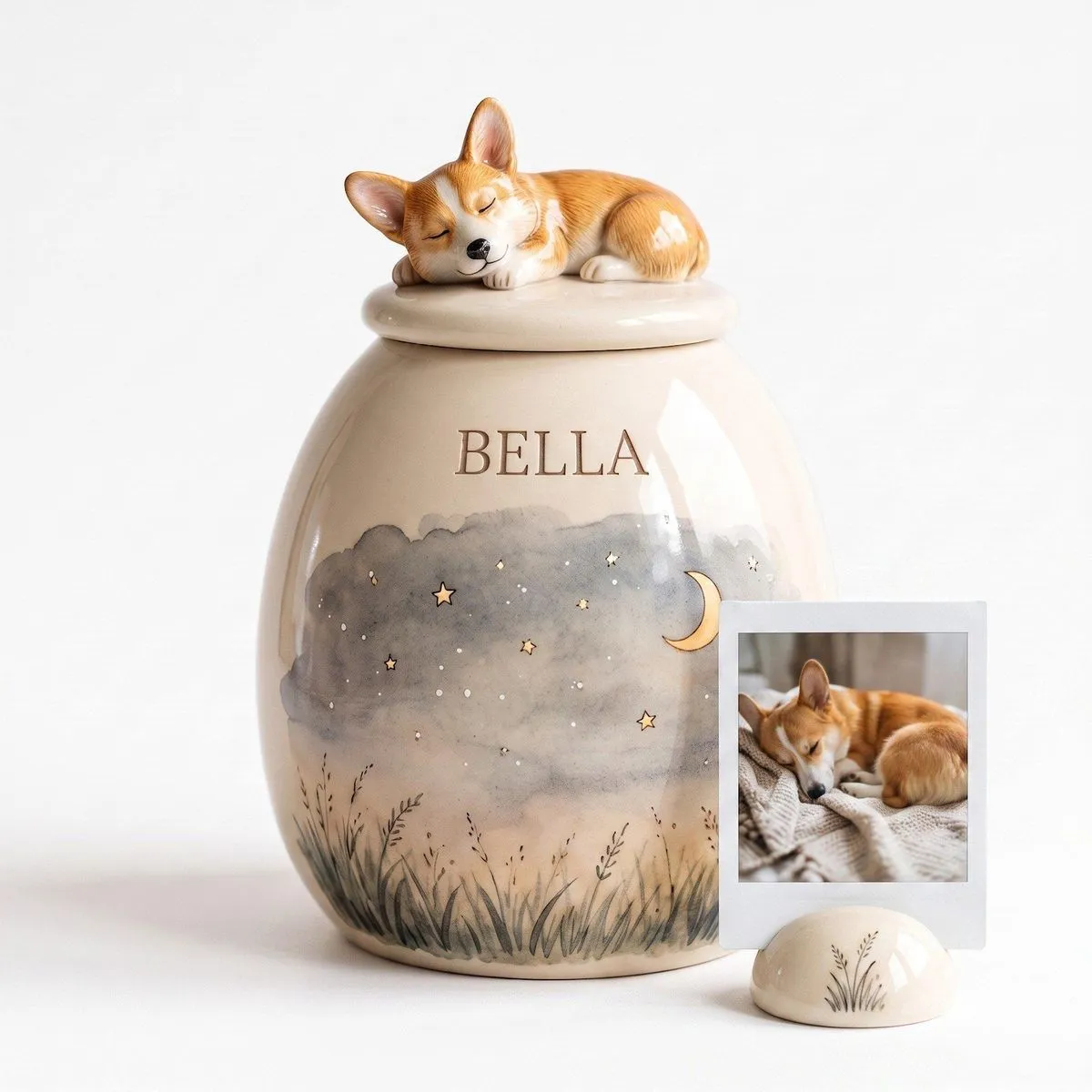
Night Sky. The cloud, stars and grasses are painted, so the surface stays smooth under your hand, and the scene carries on round the side you cannot see here.
What is the difference between painted and raised decoration?
The difference between painted and raised decoration on a Pepple Studio urn is whether the design is part of the surface or added on top of it. Painted work is flat: you see it but cannot feel it. Raised work, often called relief, is clay shaped separately and joined to the jar while the clay is still workable, so it throws small shadows and looks different as daylight moves round a room. A few designs sit between the two. Slip is clay thinned to a liquid, and laid on thickly it leaves a mark you can feel with a fingertip. The Celestial design uses it for the stars, which go on over the dark glaze in a pale slip, and Ocean & Nautical uses it for the white tops of the waves, the one part of that sea with any texture. Rainbow & Shooting Stars mixes both methods outright: the rainbow over the lid is painted, and the white clouds on the body are raised.
| Design | How it is decorated | What you notice |
|---|---|---|
| Cherry Blossom | Painted onto dried clay before firing | Pink sits in the surface, not on it |
| Night Sky | Painted all the way round | No back to the jar |
| Ocean & Nautical | Waves in three blues, painted wet into wet | Only the white crests can be felt |
| Celestial | Dark glaze, stars added in pale slip | Stars stand slightly proud |
| Pastel Clouds | Raised clouds | Clouds stand out from the glaze |
| Poppy & Butterfly | Raised poppies round the whole body | Flowers stand clear of the jar |
| Tulip | Raised petals rolled thin and joined | Glaze gathers between petals |
| Angel Wings | Raised feathers laid on one by one | Wings left matte or nearly so |
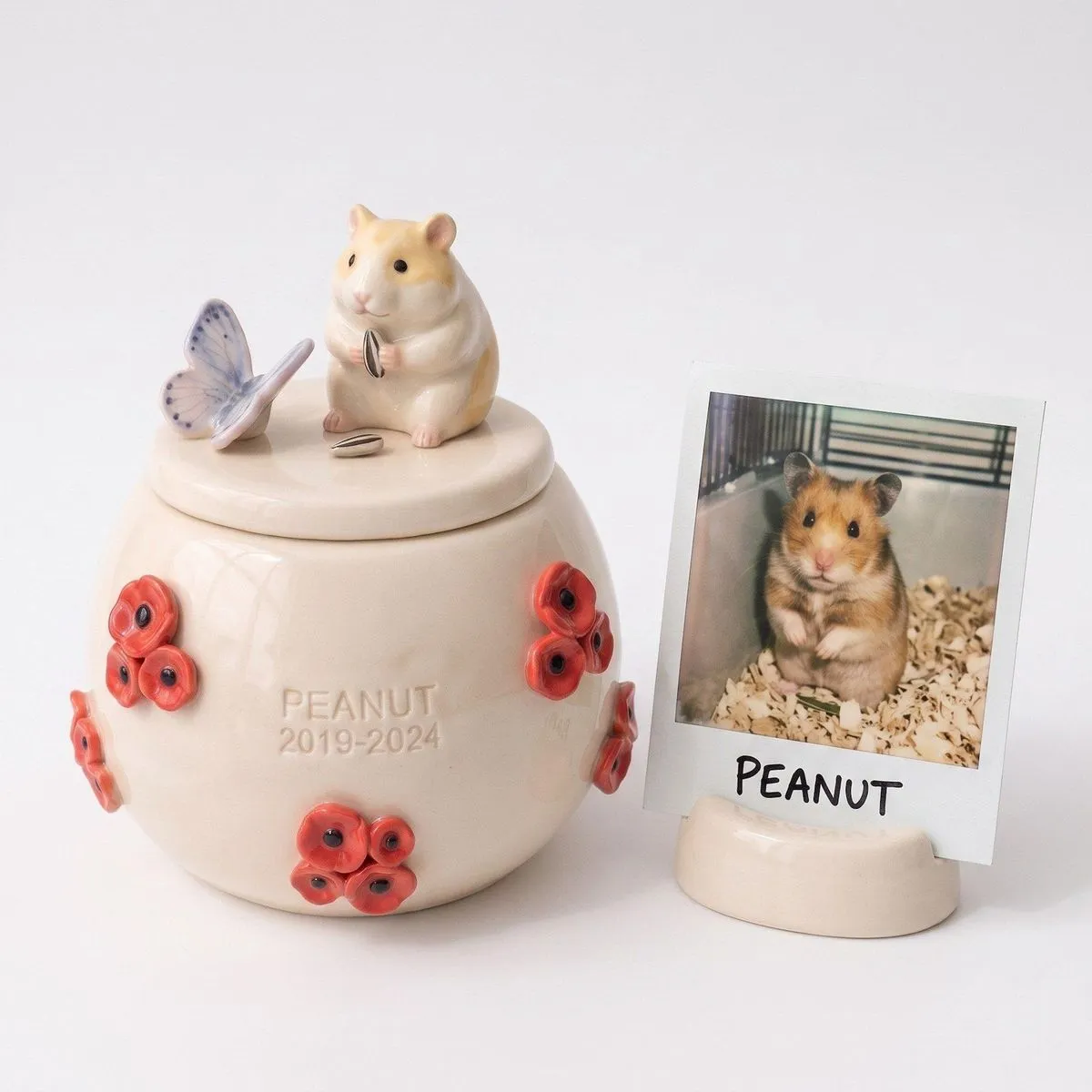
Poppy & Butterfly. Each cluster of poppies is built out from the jar rather than painted on it, and the butterfly on the lid is one of five styles to choose from.
Is raised decoration on an urn more fragile?
Raised decoration on a Pepple Studio urn is at its most fragile while it is being made. Before firing, a raised flower or feather is soft clay joined to soft clay, and the join has to be made at the right moment. On the Tulip design, petals attached when the clay is too wet sag, and petals attached when it is too dry crack away from the jar in the kiln, so the work happens in a short stretch while the clay is just right.
That risk lands on the studio as time. On Angel Wings the feathers are laid on one by one while the clay is soft, starting at the tip and working inwards so each overlaps the next, and a pair of wings takes longer than the figurine itself. Heavy relief on a thin body also raises the chance of a crack in a high-fire kiln, which why we fire at 1200°C goes into. Once a raised design is fired and finished, the practical difference for you is shape: the raised parts are the parts that stand out, so they are what to keep clear of when you dust or move the urn.
What is an alcove urn?
An alcove urn is a jar with an arched opening shaped into its front, and at Pepple Studio the sculpted pet sits inside that arch, facing out at you, rather than on the lid. The arch is formed as part of the jar, not fixed on afterwards. Three designs use it: Floral Alcove, with painted flowers round the lower body in a choice of botanical styles; Sky Alcove, painted sky blue with clouds and birds; and Woodland Diorama, glazed sage green.
An alcove gives the figurine a setting instead of a perch. In Woodland Diorama the pet shares the opening with a tiny mossy log and an acorn, so the arch reads as a corner of a wood. Because the pet is inside the jar, the lid carries painting instead: a floral rim on Floral Alcove and a constellation on Sky Alcove. The name goes above the opening, painted by hand on Woodland Diorama, across a cloud banner on Sky Alcove and in a cursive script on Floral Alcove.
Building a small scene on the lid
On designs where the pet sits on top, the lid can carry a small scene of its own, from the mushrooms and moss of Forest & Mushroom to the cloud a pet sinks into on Sleeping Cloud. How those scenes are put together piece by piece, with photographs from the workshop before firing, is in how the scene on a pet urn lid is built.
Where the name goes
The name follows the same logic as the decoration. On some designs it is cut into the clay or set on a raised plaque, so you can feel it; on others it is printed or painted, so it sits flat as part of the design. Which method each design uses, how long a name can be and what happens if it is spelled wrong are all set out in how a pet’s name goes on an urn.
Seeing every design side by side
Each design mentioned here has its own page with photographs and a note on how it is decorated, and they are all gathered on the urn themes page. To see them on finished urns, go to the ceramic urn collection.