Sculpted vs Printed Pet Urns
There are four common ways to put your pet onto a memorial urn: print a photograph onto it, paint a portrait on it, engrave the name, or sculpt the animal in three dimensions. They cost differently, last differently, and suit different people. Here is the honest comparison.
Last updated August 2026
| Method | Dimension | Likeness | Turnaround | Cost |
|---|---|---|---|---|
| Photo printing / decal | Flat — 2D image on a curved surface | Exact, because it is literally the photograph | Days | $ |
| Hand-painted portrait | Flat, with brushwork texture | Depends entirely on the painter; good ones are very good | Days to a week | $$ |
| Engraved name only | Shallow relief, no likeness | None — identifies rather than depicts | Days | $ |
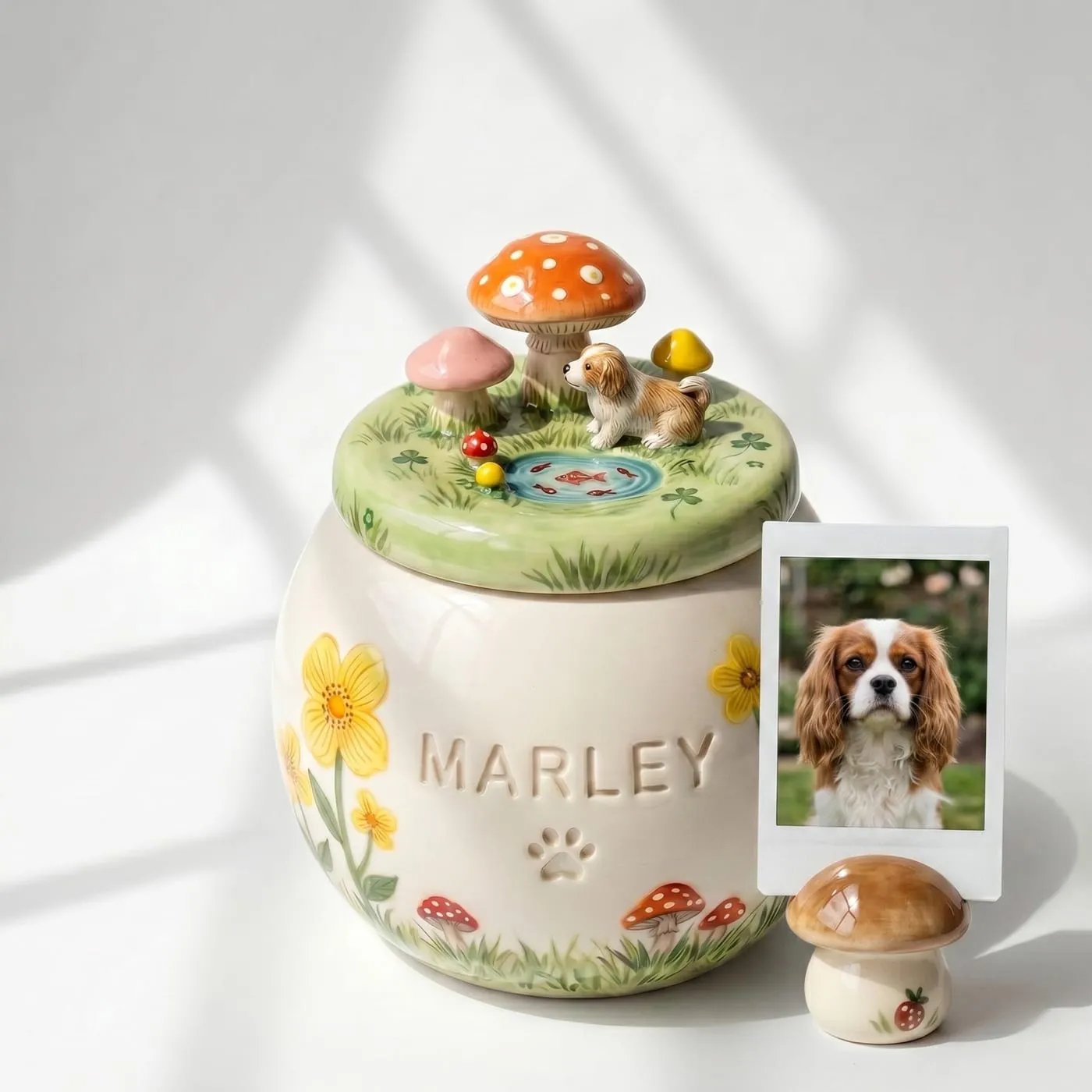
| Hand-sculpted 3D figurine | Fully three-dimensional; you can pick it up and turn it | Depends on the sculptor and how good your photos are | Weeks | $$$ |
Photo printing is the most accurate and the least present
A printed decal reproduces your photograph exactly. Nothing else on this list can match that for pure accuracy — a sculptor is interpreting, a decal is copying.
What you give up is presence. It remains a picture of your dog on a jar, viewed from one angle, in the same way a framed photo is. For some people that is precisely right and they should buy it: it is faster, cheaper, and exact.
The one technical caveat is that decals are fired at low temperature onto the finished glaze rather than under it. On a piece handled regularly over decades, edges can eventually show wear. On a piece that sits on a shelf, this is largely theoretical.
Hand-painted portraits sit in between
Painted under the glaze, a portrait is as permanent as the pot. Quality varies enormously with the painter — a good ceramic portraitist produces something a decal cannot, and a mediocre one produces something worse than a decal.
Still two-dimensional, but with brushwork the eye reads as made rather than reproduced.
What sculpting actually gives you
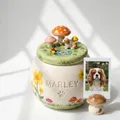
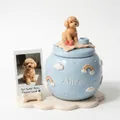
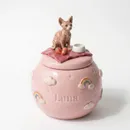
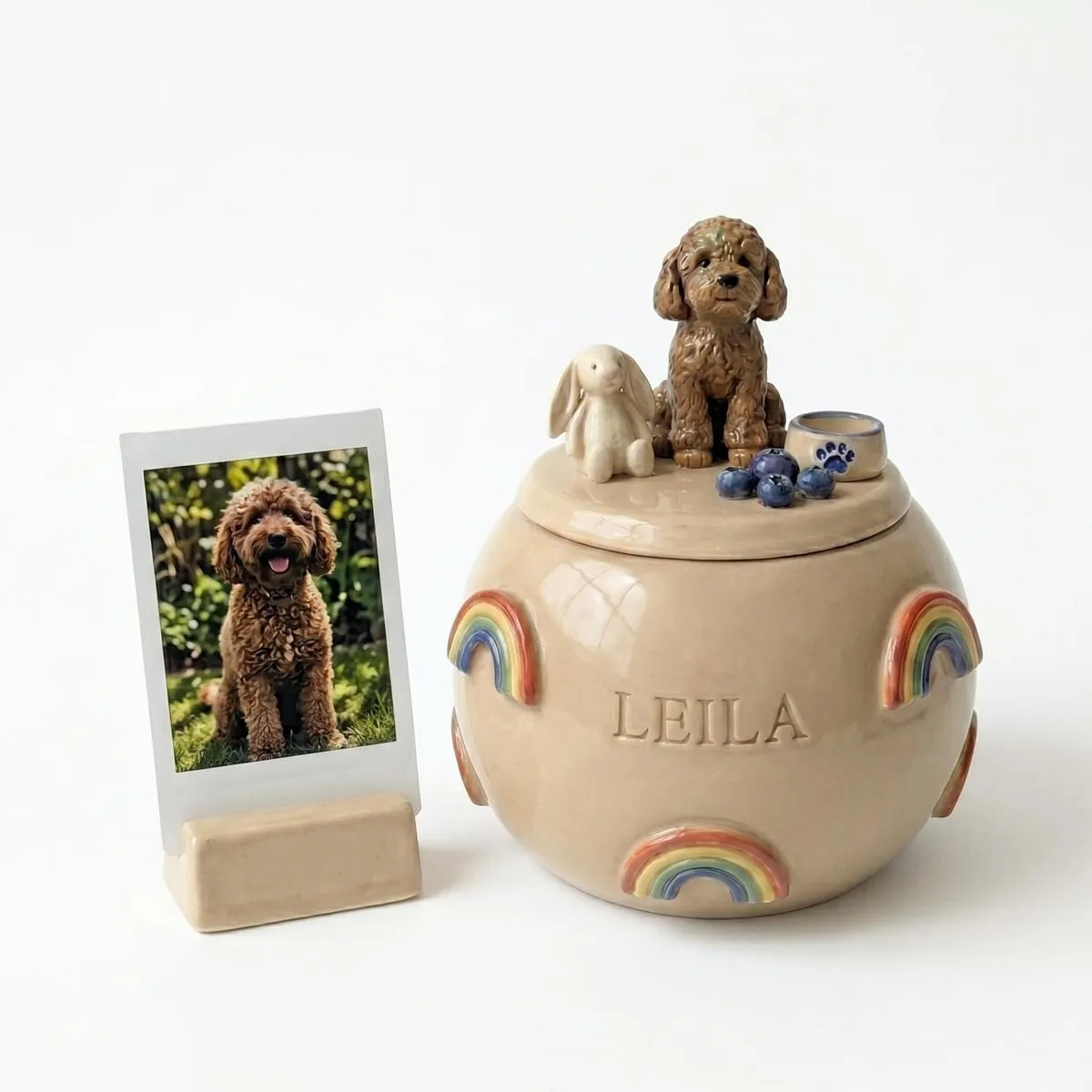
A sculpted figurine is the animal as an object. It occupies space, casts a shadow, and changes as you walk past it. People pick it up. Nobody picks up a photograph.
It is also the only method where the particular animal has to be understood rather than copied. The sculptor has to work out how that dog held its head, where the weight sat, how the ears actually folded — information spread across several photographs rather than contained in one.
That is the reason it takes weeks rather than days, and the reason it costs more. It is also the reason it can go wrong in a way a decal cannot: a sculpture that misses the likeness is a worse object than an accurate print.
How we reduce that risk
- We ask for three or four photographs from different angles, not one.
- We photograph the raw, unfired sculpture and send it to you before firing. Clay is still soft at that point, so the pose, the ears and the expression can all still change.
- If we cannot see enough in your photos to be confident, we say so before starting rather than guessing.
Which should you choose?
- You need it quickly — printing. Weeks are weeks and no amount of wanting changes that.
- Budget is the deciding factor — printing or engraving. Both are honest choices and neither is less respectful.
- You want the exact photograph preserved — printing. A sculpture is an interpretation, however good.
- You want an object rather than an image — sculpting. This is the only method that produces one.
- Your pet had a distinctive shape — a curled Shiba tail, Corgi ears, a Poodle coat — sculpting captures what a flat image flattens.
What we make
We only do the last one. Every piece we make is sculpted by hand and fired at 1200°C, which means we are the slowest and among the more expensive options here. If one of the others fits you better, that is a perfectly good outcome and we would rather you knew.
See the work
Have a look at what sculpting produces, and what we watch for in specific breeds.